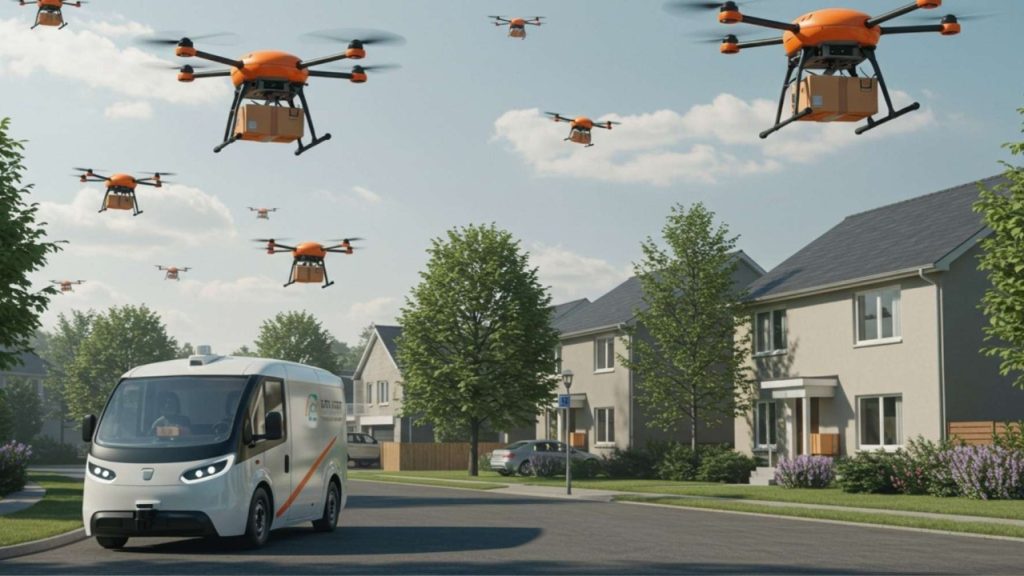
Across the world, smart cities are integrating drones into the fabric of their transport and logistics systems. Their speed and ability to bypass poor or congested road infrastructure make them ideal for time-sensitive, short-distance deliveries.
In logistics, the first mile marks the journey’s starting point, where goods are collected directly from manufacturers or suppliers and transported to local or regional hubs. The middle mile forms the vital connective layer between collection hubs and local distribution centers. It typically covers longer distances, sometimes extending across regional or national boundaries. In this phase, cargo drones with extended flight endurance and Beyond Visual Line of Sight (BVLOS) capabilities are being tested to transport bulk shipments more efficiently between depots. Finally, the last mile represents the final delivery leg from distribution centers to end consumers. This segment directly impacts customer satisfaction and delivery speed, making it the focal point of urban drone logistics innovation.
As cities become denser and consumers demand ever-faster delivery times, drones can be a viable solution to the “last-mile” challenge that is the most expensive and complex stage of logistics.
Why Drones?
According to the UK Department for Transport’s “Future of Flight Scenarios Futures Research” Report, the environmental impact of drone delivery could be substantial. While light goods vehicles (LGVs) currently deliver about 20.5 parcels per hour compared to drones’ 8, Unmanned aircraft systems (UAS) operations produce zero tailpipe emissions, significantly reducing total carbon output. The study projects that even as electric LGVs become more common by 2050, drones will remain a critical supplement to ground fleets because they’re cleaner, faster, and more resilient logistics models for urban environments.
Drones are already proving their worth in real-world applications such as medical supply transport, where they deliver blood, vaccines, and emergency aid to remote or congested regions, bypassing unreliable road networks. This success is fueling public and government confidence in their broader deployment within cities. If you’re wondering whether drones would replace delivery drivers, check out our previous blog here.
However, challenges remain: regulatory complexities, safety protocols, infrastructure costs, and public concerns over noise and privacy continue to influence the pace of adoption. Despite these barriers, drones will have an indispensable role across the entire logistics chain, changing how goods move through the first, middle, and last miles of delivery.
Recent Developments
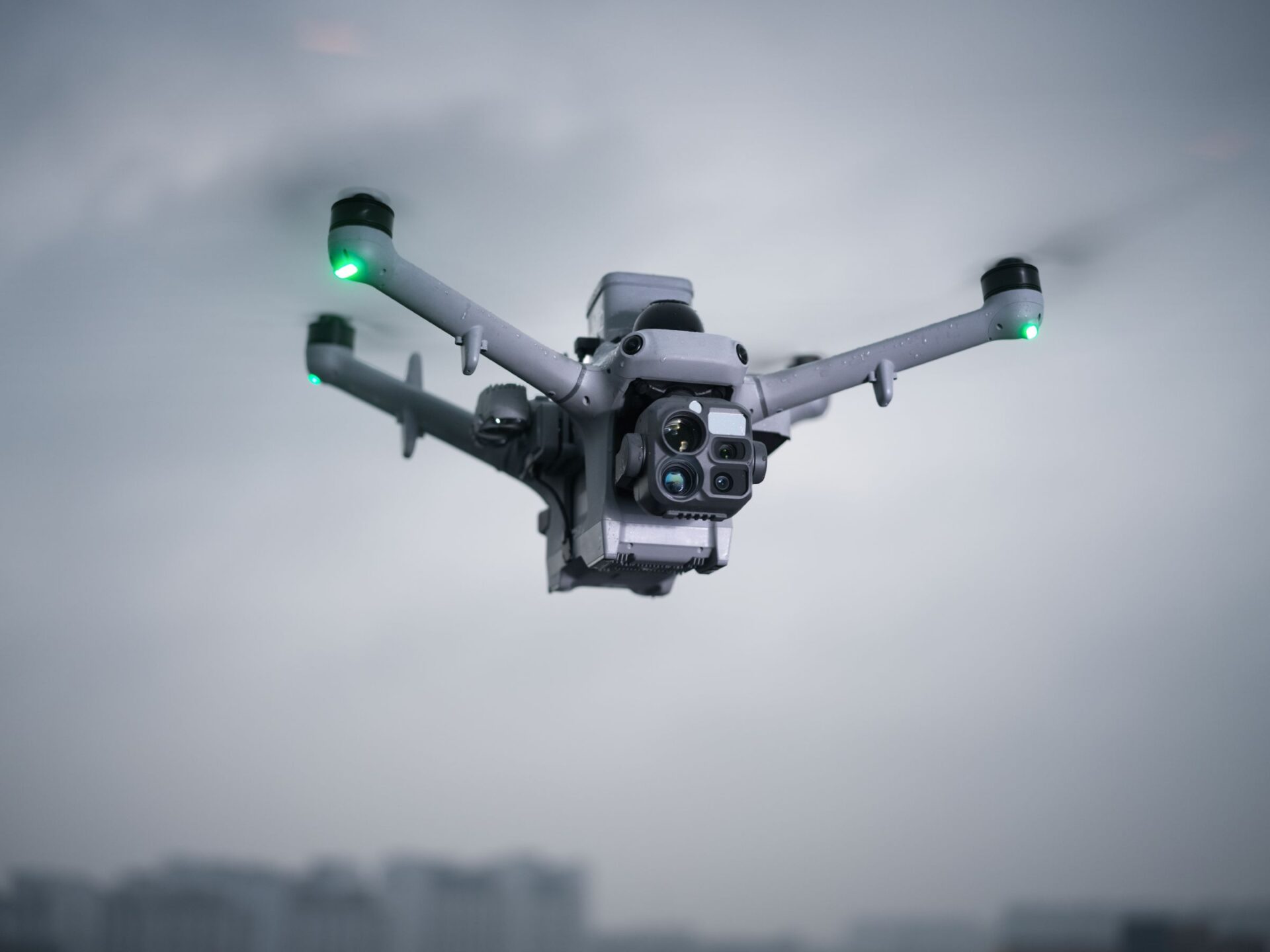
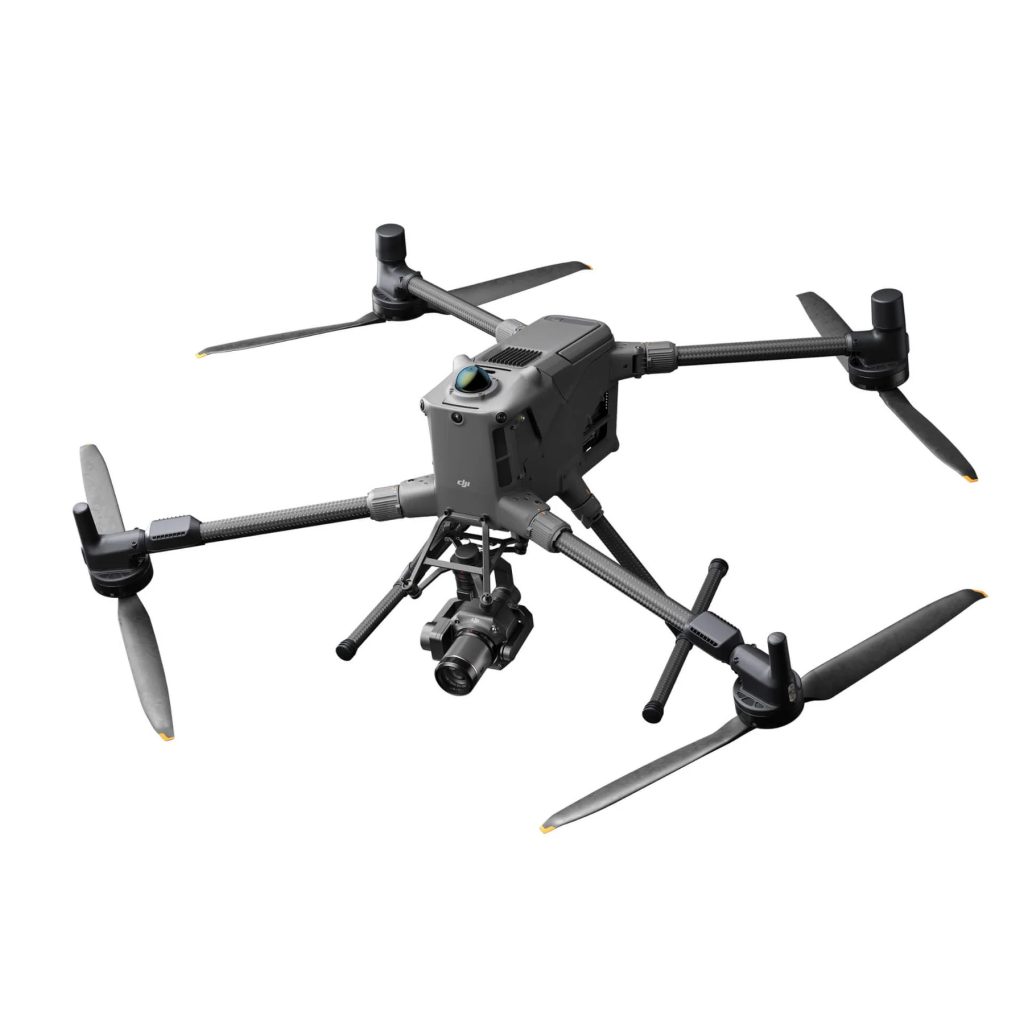
On the technology front, DJI, a global drone company has launched the FlyCart 30 (FC30), a high-performance logistics drone designed for aerial delivery. It achieves speeds of 20 m/s, carrying 30 kg payloads over 16 km or 40 kg over 8 km in single-battery emergency mode. Its IP55-rated protection, wide operating temperature range (-20°C to 45°C), and wind resistance up to 12 m/s make it suitable for challenging environments, from urban centres to offshore platforms. Equipped with advanced radar, vision systems, Automatic Dependent Surveillance–Broadcast (ADS-B) integration, and an emergency parachute, the FlyCart 30 ensures operational safety and precision.
Building on the success of the FlyCart 30, DJI has now introduced the FlyCart 100, a next-generation heavy-lift cargo drone engineered for mission-critical logistics in challenging environments. With a maximum takeoff weight of 149.9 kg, it can carry up to 80 kg with a single battery or 65 kg with dual batteries, significantly expanding its load capacity compared to its predecessor. The drone features intelligent cargo handling and two transport modes: a flagship hoist system with retractable rope and a dual-electric fixed-rope version for flexible operations. For safety, the FlyCart 100 integrates Light Detection and Ranging (LiDAR) millimetre-wave radar, a five-directional vision array, and a built-in parachute, allowing reliable flight even at altitudes up to 6,000 metres. With a range of up to 26 km (unloaded) and 6 -12 km fully loaded, it’s a major leap toward scalable heavy-duty aerial logistics.
Recent research on “Drone-as-a-Service for Last-Mile Delivery: Evidence of Economic Viability” demonstrates that drone delivery models whether owned or operated as a service offer strong financial performance, with higher Net Present Value (NPV) and Return on Investment (ROI) over a five-year period compared to motorcycle-based deliveries. Another study found drone deliveries to be significantly more cost-effective, averaging ~£0.92 per delivery versus ~£3.97 for a comparable four-mile trip using an electric van, while also improving accessibility for individuals with limited transport options.
Full-scale deployment hinges on the legalisation of BVLOS operations. Encouragingly, the UK Civil Aviation Authority (CAA) has launched six BVLOS and medical delivery trial projects within controlled airspace, signalling a major step toward scalable, long-range drone logistics in 2026.
Urban Last-Mile Delivery in 2026
The introduction of the UK Specific Operations Risk Assessment (SORA) framework establishes a structured route for BVLOS and urban delivery approvals, marking a major step toward routine, scalable drone logistics. Complementing this, the new Digitising Specific Category Operations (DSCO) platform modernises the authorisation process, enabling quicker and more transparent approvals for commercial drone operations. SORA also promotes consistent, risk-based safety assessments, helping operators demonstrate compliance more effectively while strengthening public and governmental trust in drone delivery systems.
The UK’s Future of Flight Action Plan, announced in March 2024, signals one of the most ambitious changes in modern logistics and aviation. It also includes digital platforms to simplify drone operation approvals, reduced reliance on temporary airspace restrictions, and the development of drone “vertiport” infrastructure, small-scale airports for vertical take-off and landing (eVTOL) aircraft. Backed by £125 million in government and industry investment, the plan outlines a roadmap for integrating drones, electric vertical take-off and landing aircraft (eVTOLs), and other autonomous aerial systems into national transport infrastructure by 2026. According to the plan, drone deliveries will become commonplace by 2027, with BVLOS trials already proving the concept’s viability.
Critical regulatory enablers coming into force by 2026 include:
- Direct Remote ID requirements implemented from January 1, 2026, allowing drones to broadcast identification and location data for airspace awareness
- Product requirements via class-marking to improve safety and security from the point of manufacture
- Extended Flyer ID training for drone users operating devices over 100g, improving safety understanding across the operator ecosystem
- Collision-avoidance technology mandates ensuring drones can detect and avoid mid-air incidents with other aircraft
The CAA’s BVLOS Roadmap details three operational pathways for drone deployment by 2027: Atypical Air Environment (for infrastructure inspections), Low-Level Urban BVLOS (for last-mile delivery in cities), and Fully Integrated BVLOS (for broader airspace use). The Low-Level Urban pathway is key for urban delivery disruption, progressing from specialized trial corridors to multiple operators over both controlled and uncontrolled airspace by 2028-2029. Real-world examples include NHS drone delivery trials, cutting surgical implant delivery times by 70%, and law enforcement use of drones to rapidly identify suspects, showing drones’ potential to improve public services and urban logistics. The government expects these innovations to increase the UK economy by £45 billion by 2030, underlining drones’ disruptive potential for last-mile delivery in urban areas starting 2026.
Priority Use Cases Driving 2026 Implementation
Government priorities explicitly focus on use cases delivering clear public value. The UK government’s Drone Ambition Statement forecasts that consumer delivery business models will grow in significance from 2025, with drones initially serving emergency, high-value goods, or remote area services before expanding to broader urban consumer markets. By 2030, the statement envisions drones delivering a wide range of products for both emergency and commercial customers, without raising road congestion and emissions, indicating substantial deployment activity throughout the 2026-2027 transition period.
In 2026, drones will disrupt urban last-mile delivery through carefully regulated, use-case deployments that operate within controlled airspace under standardized regulatory frameworks. The UK government’s strategic regulatory approach is evidenced through coordinated policy documents, substantial funding commitments, and collaborative industry engagement. Collectively, these initiatives position 2026 as the year when urban drone delivery advances from experimental trials to full operational deployment. This progression is set to generate measurable economic, environmental, and social benefits for communities across the country.
Download Our FREE RPC-L1 Guide
Understand everything you need to know about moving towards commercial drone operations with our RPC-L1 guide.
- Understand what RPC-L1 is and who it is for
- Learn how the CAA transition impacts operators and training routes
- Get a clear breakdown of requirements, costs and next steps
Related Posts

Top 5 Drones for Security in 2024
Drones or unmanned aerial vehicles (UAVs) are aircraft either controlled by pilots from the ground or autonomously following a pre-planned flight path. Unlike fixed CCTV security systems, drones provide dynamic surveillance capabilities, outpacing ground patrol land coverage by up to 86%. Security drones can carry multiple sensors, such as thermal, night vision, and zoom, to highlight […]
Introducing our Partnership with Wingtra…
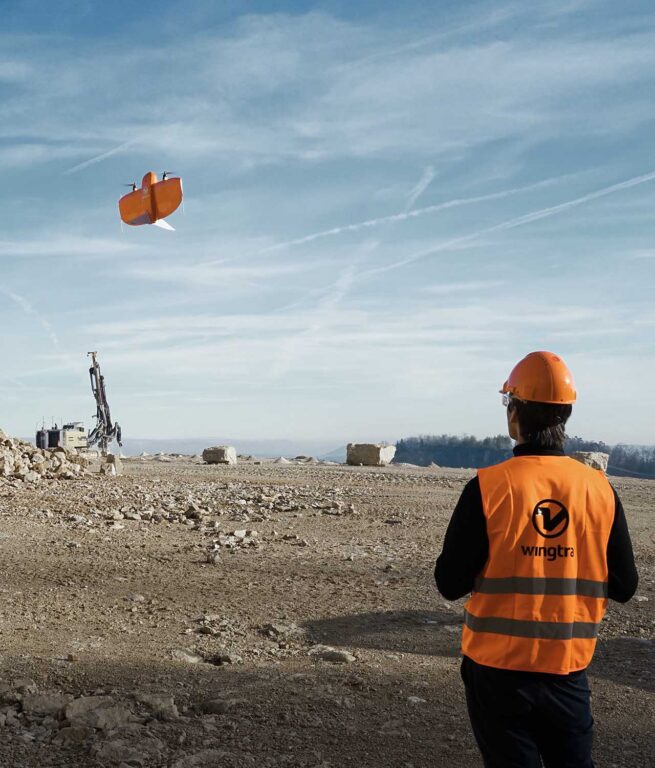
Coptrz are proud to announce our strategic brand partnership with Wingtra Coptrz and Wingtra – the Swiss-based VTOL fixed-wing drone manufacturer – have announced a new agreement with COPTRZ becoming the first Premium Partner in Europe. Coptrz and Wingtra began working together in 2017 and has been expanding their footprint in the UK market ever […]
Drones and Topographic Surveying: A Match Made in Heaven
Drones were once seen as futuristic devices which were the preserve of the military and scientific projects. But if one sector embodies the move of drones into the mainstream, it is in topographic surveying. This is where unmanned aircraft are now a fundamental part of modern map making. It is accepted that drones have singlehandedly […]