Most drone training mistakes start with a simple misunderstanding: assuming the certificate is the whole answer.
RPC-L1 Part A is now one of the most important training decisions for UK drone operators moving into, or already operating within, the Specific Category. It gives remote pilots a recognised competence route for VLOS operations, but it should not be treated as a magic pass that solves authorisation, operations manuals, site procedures or aircraft-specific training.
That distinction matters commercially. A trained pilot is valuable. A trained pilot sitting inside a properly governed operating system is far more valuable.
The CAA explains that every Specific Category Operational Authorisation sets out the level of remote pilot competency required, and that remote pilots must meet those competency requirements whenever flying under that authorisation. It also states that RPCs do not cover all operational scenarios or all UAS types, so operators must make sure pilots have the right operational and UAS-specific training as well.
What is RPC-L1 Part A?
RPC-L1 Part A is the Level 1 Remote Pilot Certificate route for VLOS operations in the Specific Category.
The CAA currently describes RPC-L1 as having:
- Part A: VLOS
- Part B: BVLOS with Visual Mitigations
Part B is optional and is not required to obtain RPC-L1. A pilot can gain RPC-L1 by completing Part A only. The CAA also lists RPC-L1 as requiring a Flyer ID, having no minimum age and being valid for five years.
For most organisations starting or maintaining professional VLOS drone operations, RPC-L1 Part A is the logical training route.
Why RPC-L1 Part A matters commercially
The commercial value is not just “we have a certificate”.
The value is:
- Your pilots have a recognised competence standard.
- Your organisation can evidence a structured training decision.
- Your Operational Authorisation conversation becomes cleaner.
- Your procurement and client responses become more credible.
- Your internal risk controls become easier to defend.
A Head of Operations does not just need a pilot who can fly. They need a pilot whose competence can be evidenced, mapped to the work being done and kept current over time.
What RPC-L1 Part A does not do
This is where many operators go wrong.
RPC-L1 Part A does not, by itself, authorise the flight. It is a competence certificate. The legal permission to carry out Specific Category operations sits with the operator’s Operational Authorisation.
For PDRA01, the CAA states that remote pilots must hold a valid UK Flyer ID and a valid RPC-L1 or GVC, but it also requires them to follow the relevant regulation and be qualified as required by the Operations Manual. The UAS Operator must maintain records of each flight and make them available to the CAA on request.
In plain English: RPC-L1 Part A is necessary for many Specific Category VLOS operations, but it is not the whole compliance system.
Who should take RPC-L1 Part A?
RPC-L1 Part A is relevant for:
New commercial drone pilots
Pilots entering professional drone work need a route that aligns with the current CAA framework rather than a legacy pathway.
Existing GVC holders planning ahead
The CAA confirms that the GVC will stop being issued on 31 December 2027, although existing GVCs may still be accepted until expiry where the Operational Authorisation clearly allows it.
Enterprise drone teams
Organisations using drones across sites, teams or departments need repeatable competence standards.
Public sector and infrastructure teams
Public safety, utilities, inspection and surveying teams face higher levels of scrutiny. Training evidence matters.
The practical question: what operation are you training for?
Before booking RPC-L1 Part A, ask:
- Are we flying in the Open Category or Specific Category?
- Do we need an Operational Authorisation?
- Which pilots need training now?
- Which pilots may need RPC-L1 Part B or RPC-L2 later?
- Which aircraft categories do we use?
- How will we track certificates, expiry dates and currency?
That turns RPC-L1 from a course purchase into a capability decision.
Why Coptrz for RPC-L1 Part A?
Coptrz is listed by the CAA as approved for L1, GVC and A2 CofC. Coptrz also offers online and face-to-face RPC-L1 Part A routes, practical flight instruction and assessment, GVC conversion and progression into higher RPC levels.
The commercial point is simple. If your organisation is building drone capability, you want a training partner that understands the CAA framework, the operational reality and the evidence clients will ask for.
What should you do next?
If you are training one pilot, choose the route that matches their immediate operation.
If you are training a team, step back. Build a competence plan first.
The right plan should show:
- Who needs RPC-L1 Part A
- Who may later need Part B or RPC-L2
- Which Operational Authorisations the pilots will work under
- How currency and evidence will be maintained
- How training records will be held
FAQs
No. The CAA says GVC and RPC-L1 are broadly similar in the level of competency needed, but they are different routes within the current framework. RPC-L1 is the forward route as GVC issuance ends on 31 December 2027.
It helps evidence pilot competence for Specific Category VLOS operations, but you still need the correct Operational Authorisation where required.
Yes. The CAA states that you must have a Flyer ID before you can get any other qualification.
No. Part B is optional. It is relevant where BVLOS with Visual Mitigations is needed.
The CAA lists RPC-L1 as valid for five years.
If your organisation is preparing pilots for RPC-L1 Part A, Coptrz can help you choose the right route, train your pilots properly and build the competence evidence needed to move forward with confidence. Speak to the Coptrz training team today.
Author bio:
Simon Harris is Managing Director of Coptrz, supporting UK organisations with drone training, compliance and operational capability.
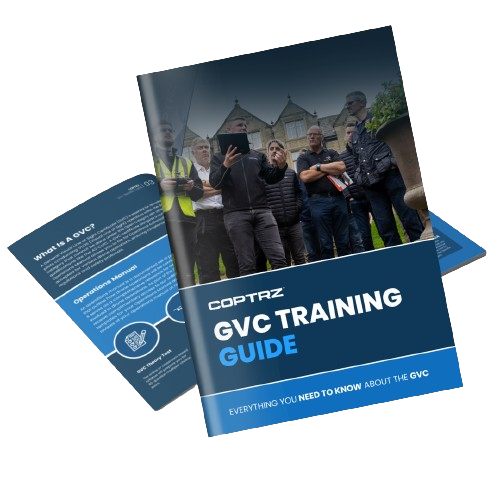
Download Our FREE RPC-L1 Guide
Understand everything you need to know about moving towards commercial drone operations with our RPC-L1 guide.
- Understand what RPC-L1 is and who it is for
- Learn how the CAA transition impacts operators and training routes
- Get a clear breakdown of requirements, costs and next steps
Related Posts

Matrice 200 Series V2: What’s New & Should You Upgrade?
When DJI first announced the original Matrice 200 Series back in February 2017, it was seen as a clear commitment by the company towards the professional or ‘enterprise’ sector. We’d already seen the Matrice 600 which was clearly targeting the broadcast and filmmaking communities, but with the majority of DJI’s fleet still mostly within the […]

Anti-Malaria Drones: The Fight Against an Ancient Disease
The fight against malaria continues to be one of the most devastating challenges, particularly in the world’s most vulnerable communities. Malaria remains a significant cause of mortality and economic burden in Africa, which bears 96% of malaria deaths worldwide and costs £12 billion per year. With this in mind, it’s easy to see why drones […]

Navigating the Future of UAS/RPAS Operations: Carrying Dangerous Goods
Introduction to CAP2555 The Civil Aviation Authority (CAA) has recently released a new guidance document, CAP2555. This crucial document provides policy and guidance for the operation of Unmanned Aircraft Systems (UAS) and Remotely Piloted Aircraft Systems (RPAS) in the Specific Category, specifically when carrying dangerous goods (DG). Although not a regulation, CAP2555 is designed to […]