There are some crucial elements to consider before every drone flight to ensure your aircraft, the environment and the people within it will be safe. A pre-flight checklist will ensure you take into consideration every factor which may impact on the safety of your flying time.
Pilots like mnemonics to help them easily remember pre-flight checks. Airline captains use memory aids like CIGAR – controls, instruments, gas, altitude and run-up to prepare for flight – or GUMPS when readying for landing – gas, undercarriage, mixture, props and safety.
Our pre-flight drone checklist works with SWEETEN – Safety Kit, Weather/wind, Environment, Equipment, Take-off, Emergency-planning, Notifications.
Safety Kit
The safety kit is one of the most important parts of a pilots toolkit. Your safety kit should include an anemometer to perform wind checks to ensure it’s safe to fly. Safety equipment such as a hi-viz vest, hard hat & safety goggles are important for your own personal safety. Safety cones are also a key tool to have to ensure that your flight zone is marked out, for your own safety and the safety of the general public.
The COPTRZ Drone Pilot Safety Kit has been specifically designed to include all of the items you need to ensure that you are operating safely during every drone flight. In the safety kit, you’ll find an anemometer, fire extinguisher, hard hat, hi-viz vest, safety goggles, first aid kit, collapsible safety cones and heavy duty holdall.
Weather & wind
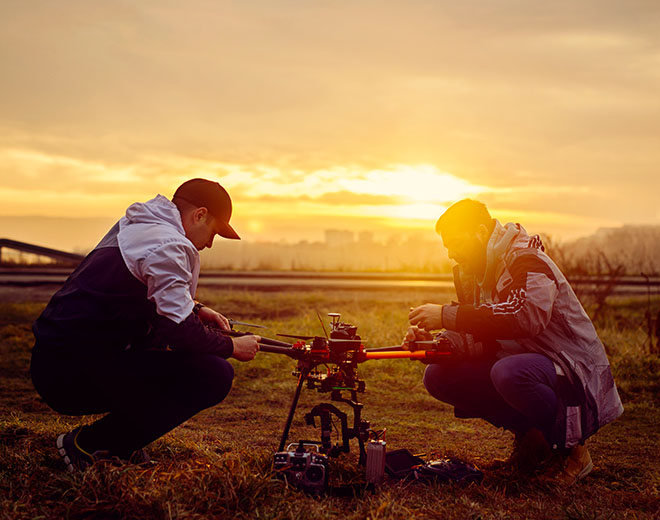
You’ll need to keep an eye on the prevailing conditions and the weather forecast for the duration of your flight. Humidity and temperature levels can impact upon your device and sun glare can dazzle you from maintaining a clear visual on your aircraft, so consider visors or sunglasses.
Taking wind direction and speed into account is critical before you even consider flying your drone in an area. Remember, gusts can whip across your fly zone without warning so take note and make allowances for exposed areas.
Environment
You’ll need to thoroughly check your flying environment before lift-off. You should incorporate the following considerations into a site safety risk assessment.
Make sure you visually clock the position of overhead wires, pylons and cables. Also, scour the area for other people and bystanders as well as spectators and animals.
Make sure your fly zone is as clear as it can be from non-essential participants and always avoid take-off and landing in areas which are populated. If these zones are obstructed, select another spot for departures and arrivals. Take stock of the topography of your fly zone to ensure you have a visible line of sight of your drone at all times.
Equipment – Aircraft Checks
You’ll need to prepare a pre-flight inspection checklist to run through to ensure your drone is in good condition. This should include checking for cracks and structural defects, loose or defective wiring and damage to solders and plugs. Ensure batteries are fully charged and perform a thorough check of your transmitter.
Periodically check your aircraft’s fail-safe functioning, including return-to-home mechanisms and recovery chutes.

Take-off preparation
Remember to undertake a range test and check your camera settings before you fly. Every flight should begin with a short hover test for around 30 seconds. Hover your device at around 5 to 6 feet from the ground in order to satisfy yourself everything is working OK and listen out for vibrations, loose items and other abnormalities.
Emergency Planning
Any sensible pilot will have some emergency planning steps pre-prepared. A working fully charged mobile phone is a must but remember some remote areas still struggle for signal. Always have someone know where you’re going and what time to expect you home.
A stocked first aid kit should be an essential part of your gear and take note of places you can reach to summon help in an emergency.

Notifications & permissions
You’ll need express permission from nearby property owners should you be flying your drone near residential properties and you may need authorisation from the landowner to be on their site. If you’re filming people, remember you are likely to need their consent to take pictures of them.
If you’re flying in controlled airspace, you’ll need to notify the relevant authority. You may need to complete a NOTAM (Notice to Airmen). There are some useful guides online which explain how to do this. There are also some great websites or apps you can download which present information on controlled, restricted, danger and no-fly areas.
Read more of our articles:
- Innovair: Using the DJI Matrice 210 for land surveying and inspection
- Fixed Wing vs Multirotor drones for surveying
- 5 tips for adding value to your drone service
- LiDAR sensors for drone: top 5 options
Download Our FREE RPC-L1 Guide
Understand everything you need to know about moving towards commercial drone operations with our RPC-L1 guide.
- Understand what RPC-L1 is and who it is for
- Learn how the CAA transition impacts operators and training routes
- Get a clear breakdown of requirements, costs and next steps
Related Posts
Drones & GDPR: The Rules You Should Follow
The introduction of GDPR is causing business owners across Europe headaches at the moment. As a business owner, you would be forgiven for thinking that GDPR is focused on permission-based marketing and the systems companies need to adopt to ensure customers can opt-in and opt-out of receiving promotional materteral. Therefore, GDPR is of little interest […]
5 Tips for Hiring a Drone Service Provider
The drone industry is ever evolving with hundreds of companies adopting the technology every year. It’s now beyond doubt that drones can definitively save you time, save you money and reduce the risk of your operations, however, it can’t be ignored that there is still a barrier to entry. Cost. While the price of drone […]

LiDAR vs Photogrammetry: who wins?
LiDAR vs photogrammetry. Which is best, which is more accurate, which tech will give the best results? Over the last few years, one of the most commonly searched terms (when it comes to surveying equipment) has been LiDAR Vs Photogrammetry. In today’s blog, we have debunked the myths and will talk you through the pros […]