Public safety drone teams do not operate in low-pressure environments. Their training standards should reflect that.
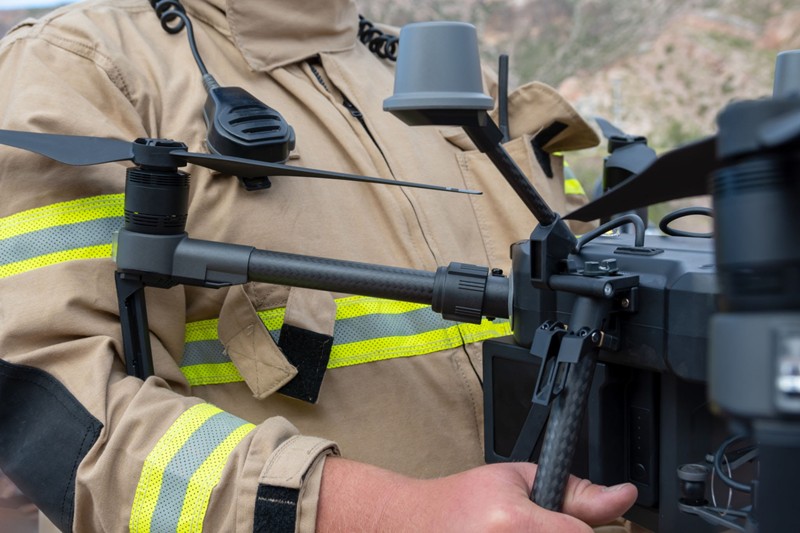
For public safety teams, drone operations are rarely routine. A pilot may be supporting a missing person search, fireground assessment, incident command, traffic collision response, flood monitoring or major event oversight.
That environment exposes weak training quickly.
RPC-L1 matters because it gives public safety drone teams a recognised competence foundation for Specific Category VLOS operations. But the bigger issue is not the certificate itself. It is whether the organisation can evidence that its pilots are competent, current, briefed and operating under the right authority.
Why public safety drone operations need stronger competence discipline
Public safety teams face three pressures at once.
First, operational urgency. The drone may be needed quickly.
Second, public visibility. Flights often happen near people, roads, property or sensitive locations.
Third, post-incident scrutiny. If something goes wrong, the question will not be “did someone own a drone?” It will be “was the operation properly authorised, planned, crewed and controlled?”
The CAA’s PDRA01 overview makes this point indirectly. For PDRA01, remote pilots must hold a valid UK Flyer ID and valid RPC-L1 or GVC, but they must also follow the relevant regulation and be qualified according to the Operations Manual. The operator must maintain flight records and make them available to the CAA on request.
RPC-L1 as the baseline, not the whole answer
RPC-L1 Part A supports VLOS competence in the Specific Category. It does not replace incident procedures, operational authorisation, aircraft-specific training, deployment protocols or crew coordination.
For public safety, that is critical.
A pilot who can pass an assessment still needs to understand:
- Incident command structures
- Dynamic risk assessment
- Airspace restrictions
- Public cordons
- Evidence handling
- Data protection
- Communications with ground teams
- Emergency procedures
- Site-specific restrictions
- Night operations where relevant
The certificate creates a baseline. The organisation must build the operating system around it.

What public safety leaders should ask
A public safety lead should be able to answer:
- Which pilots hold RPC-L1 Part A?
- Which pilots still rely on GVC?
- Which OAs apply to our operations?
- Are pilots current?
- Are deployment logs complete?
- Are site surveys and briefings recorded?
- Are aircraft maintained and logged?
- Can we evidence training by pilot, aircraft and role?
- Is our training plan aligned to future operational needs?
Weak answers here are not admin problems. They are operational risks.
Why RPC-L1 supports procurement and governance
Public safety bodies often operate under public procurement, internal governance and external scrutiny.
RPC-L1 helps because it gives a clear competence reference point. It allows decision-makers to specify training standards in procurement documents, internal policies and supplier requirements.
For example, a public safety organisation procuring drone support can ask:
- Do remote pilots hold RPC-L1 or valid GVC where accepted?
- Is the competence matched to the operation?
- Are flight logs and currency records available?
- Which RAE(PC) delivered the training?
- Does the provider understand PDRA01 and UK SORA?
The CAA lists recognised providers, including Coptrz Ltd for L1, GVC and A2 CofC.
Build a public safety competence register
A public safety drone unit should maintain a live competence register.
Minimum fields should include:
- Pilot name
- Flyer ID
- RPC-L1 or GVC status
- Certificate expiry
- Aircraft category
- Aircraft-specific training
- Incident role
- Night operation training if applicable
- Recent flight activity
- Authorisation scope
- Refresher training dates
That register should be reviewed monthly and before any major operational deployment.

Where RPC-L1 Part B and RPC-L2 may fit
Some public safety teams will eventually look beyond routine VLOS. Current CAA wording describes RPC-L1 Part B as BVLOS with Visual Mitigations, while RPC-L2 is designed for BVLOS operations in ARC-a where no other air traffic is expected.
That does not mean every public safety team needs Part B or RPC-L2 now.
It does mean leaders should understand the route before promising future capability.
What should public safety teams do now?
Start with three actions.
First, audit your current pilots and certificates.
Second, map each operation type against the required competence and authorisation.
Third, create a training plan that puts new pilots onto RPC-L1 Part A by default and identifies future progression needs.
FAQs
Yes, RPC-L1 Part A is relevant for Specific Category VLOS competence, but emergency services also need role-specific procedures, operational authorisation and internal governance.
No. RPC-L1 is a remote pilot competence certificate. Incident command and public safety procedures need separate internal training.
Existing GVCs can still be accepted until expiry where the Operational Authorisation clearly states that GVC is acceptable evidence of competence.
For future planning, yes. New GVC issuance ends on 31 December 2027, so RPC-L1 is the cleaner long-term route.
Yes. The CAA can ask to see records, and PDRA01 operators must maintain records of flights made under the authorisation.
If your public safety drone team is building or refreshing its pilot capability, Coptrz can help you create a clear RPC-L1 training route, align it to operational needs and make sure your competence evidence stands up when it matters.
Author bio:
Simon Harris is Managing Director of Coptrz, working with UK organisations to build safer, more capable and better-governed drone operations.
Download Our FREE RPC-L1 Guide
Understand everything you need to know about moving towards commercial drone operations with our RPC-L1 guide.
- Understand what RPC-L1 is and who it is for
- Learn how the CAA transition impacts operators and training routes
- Get a clear breakdown of requirements, costs and next steps
Related Posts

Navigating the Future of UAS/RPAS Operations: Carrying Dangerous Goods
Introduction to CAP2555 The Civil Aviation Authority (CAA) has recently released a new guidance document, CAP2555. This crucial document provides policy and guidance for the operation of Unmanned Aircraft Systems (UAS) and Remotely Piloted Aircraft Systems (RPAS) in the Specific Category, specifically when carrying dangerous goods (DG). Although not a regulation, CAP2555 is designed to […]
Drone Surveys: A Major Port Case Study
A survey was commissioned by a major port authority in the UK for a fuelling jetty used by a global oil major. The organisation wanted to have a direct comparison between traditional hydrographic survey techniques and drone-based survey, to ascertain whether this can be met by drones for their future needs. Preparation The survey site […]
DJI XT Pro iOS App Released
COPTRZ are pleased to announce that DJI has released the new DJI XT Pro App, designed to empower Zenmuse XT users by giving them a more simple, streamlined method of capturing thermal imaging data. The use of thermal imaging with drones is rapidly increasing, with Fire Services, Search and Rescue and Police Forces beginning to […]