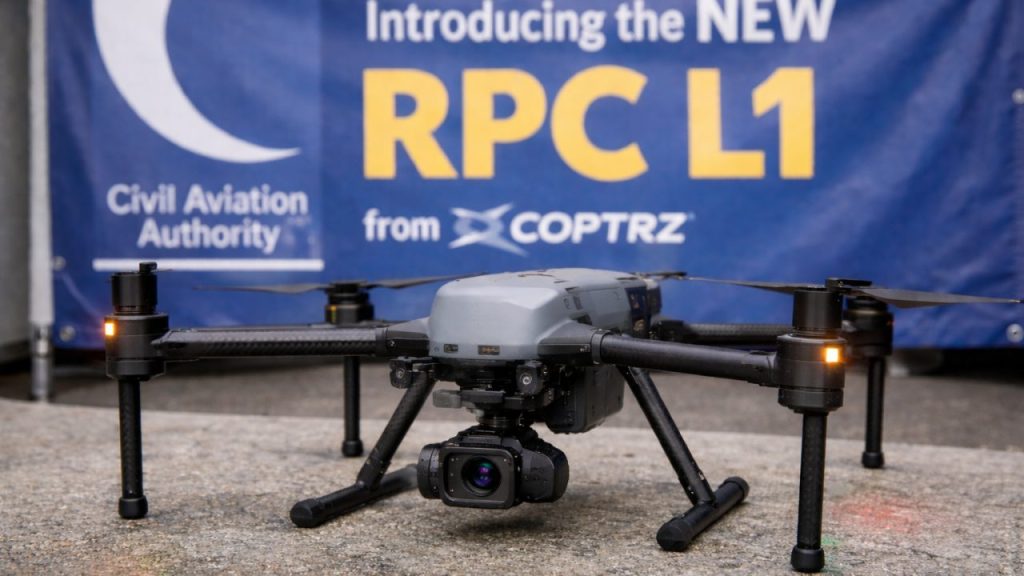
What is the RPC-L1 (Level 1 Remote Pilot Certificate)?
The Level 1 Remote Pilot Certificate (RPC-L1) is the UK Civil Aviation Authority’s new baseline certification for drone pilots operating in the Specific Category. Introduced in 2025, this certificate aligns with the modern UK SORA risk assessment framework which replaces the old “OSC” process for advanced operations. With an RPC-L1, a pilot is qualified to conduct Visual Line of Sight (VLOS) flights under a UK CAA Operational Authorisation.
Key features of RPC-L1 include:
- Eligibility: No official minimum age, though Coptrz recommend 16+. You must have a valid UK CAA Flyer ID (i.e. passed the basic online CAA Drone Code test) before enrolling.
- Training & Assessment: Completion of a theory course covering air law, navigation, meteorology, human factors, aircraft knowledge and practical flight skills. You’ll need to pass a multiple choice theory exam, complete a minimum of 2 hours of flight instruction with an approved flight instructor and a flight assessment. If you already hold a GVC, you’re exempt from the RPC-L1 theory exam.
- Operational Scope: RPC-L1 certifies you to fly drones within VLOS within the Specific Category – for example, operations in populated areas or other scenarios outside the basic Open Category rules, subject to obtaining an Operational Authorisation. When operating under a UKPDRA-01 Operational Authorisation, this effectively allows VLOS flights up to 120m AGL with drones up to 25kg.
- Validity: The certificate is valid for five years. Maintaining it requires “flight currency” – at least 2 hours of logged flight time every 90 days to ensure skills stay sharp. After five years, a refresher/renewal process is needed (such as a short course and check exam) rather than redoing the entire training.
Crucially, RPC-L1 is the first step in a new tiered certification system. It forms the foundation for higher levels like RPC-L2 and RPC-L3, which unlock beyond visual line of sight (BVLOS) and more complex operations. This makes RPC-L1 not just a standalone license, but the gateway to an evolving drone career path in the UK.
RPC-L1 vs GVC: Key Differences
How does the new RPC-L1 compare to the well-known GVC (General Visual Line of Sight Certificate)? Here are the key differences:
- Regulatory Framework: The GVC is a legacy certification tied to a pre-defined low-risk scenario (CAA’s PDRA-01 template) for VLOS flights. In contrast, RPC-L1 is built for the risk-based UK SORA framework, which replaced the old OSC system in April 2025. Though an RPC-L1 can be used to fly under a PDRA-01 Operational Authorisation. In essence, GVC = old standard (pre-set conditions), RPC-L1 = new standard (flexible, risk-assessed ops).
- Progression Path: The GVC has no formal progression beyond itself – it’s a one-off certification for VLOS. RPC-L1 is designed with progression in mind. After L1, pilots can advance to RPC-L2 (for basic BVLOS in isolated airspace), then RPC-L3 for increasingly complex missions. The RPC framework creates a clear career ladder, whereas the GVC is a dead-end in terms of higher qualifications.
- Aircraft Category Coverage: A GVC certificate covers multirotor and fixed-wing drones (up to 25kg) under one qualification. RPC-L1, however, is category-specific – you must choose either rotorcraft or fixed wing for your training. If you want to be qualified for both types, you’ll need two certificates (an RPC-L1 Rotorcraft and an RPC-L1 Fixed Wing.) The GVC offered all-in-one versatility, whereas RPC-L1 hones your skills on a specific platform first.
- Training Content & Difficulty: Both courses cover core topics like UK air law, meteorology, navigation, etc., and both require a practical flight test. However, RPC-L1’s syllabus is more up-to-date and intensive. It includes everything in the GVC curriculum plus new content on UK SORA risk assessment and operational mitigations. The practical assessment for RPC-L1 is also a bit more rigorous, with enhanced navigation drills and scenarios to test decision-making. GVC training involved preparing an Operations Manual for your organisation, whereas RPC-L1 focuses purely on the remote pilot’s competence (shifting the emphasis from operator paperwork to pilot skill). For experienced pilots, the good news is a GVC holder can transition to RPC-L1 without re-taking the theory exam – you’d just complete the theory learning course then continue with a conversion course focusing on practical elements.
- Operational Permissions: Both GVC and RPC-L1 are valid for five years and require the same ongoing flight currency (2h/90 days). In terms of usage: a GVC allows you to apply for an Operational Authorisation under the standard PDRA-01 scenario (e.g. VLOS in congested areas with prescribed distances). RPC-L1, on the other hand, is what you’ll need for any new Specific Category authorisations that involve a custom risk assessment under UK SORA from 2025 onward, in addition to the standard PDRA-01. In fact, starting January 2026, the CAA expects RPC certificates for UK SORA-based approvals – making RPC-L1 effectively the new entry requirement for most professional drone operations. Bottom line: you can still use an existing GVC for standard ops, but RPC-L1 is the future-proof choice if you plan to do more complex or advanced missions going forward.
Flight Instruction and Practical Competence
A central distinction of the Level 1 Remote Pilot Certificate is its strong emphasis on structured ground and practical flight instruction as a mandatory component of pilot certification. RPC-L1 is explicitly competency-based, meaning pilots must demonstrate safe, consistent and compliant performance in real operational conditions, not merely theoretical knowledge.
All RPC-L1 candidates are required to complete a minimum of two hours of supervised flight instruction with an approved Practical Flight Instructor. This instruction is delivered against defined competency standards and is designed to develop the pilot’s operational capability rather than simply prepare them to pass an assessment.
Flight instruction focuses on the application of knowledge in realistic scenarios, including:
- Operational planning and risk assessment aligned to UK SORA principles
- Aircraft handling, control accuracy and energy management appropriate to the selected aircraft category
- Navigation, airspace awareness and situational awareness
- Abnormal and emergency procedures
- Decision making, threat and error management, and workload control
- Compliance with operating procedures and Operational Authorisation conditions
This instructional phase applies to all candidates, including experienced pilots. While holders of a valid GVC are exempt from the RPC-L1 theoretical knowledge examination, they must still complete the required flight instruction and pass the practical flight assessment. This ensures consistent, evidence-based competence across all RPC-L1 certificated pilots.
The instructional phase culminates in an independent Practical Flight Assessment, providing objective evidence that the pilot meets the CAA’s RPC-L1 performance standards.
Coptrz – Your Partner for RPC-L1 Training
Coptrz is at the forefront of delivering the new RPC-L1 certification in the UK. As the leading CAA-approved training provider (Recognised Assessment Entity), Coptrz was among the first to receive approval to offer the RPC-L1 course. Here’s why training with Coptrz stands out:
- Expertise & Recognition: Coptrz is an established name in drone training with over 12,000+ pilots trained and a 99% pass rate on courses. We are trusted across industries – enterprise clients like the BBC and Balfour Beatty have chosen Coptrz to train their drone teams. Coptrz’ courses are OFQUAL accredited and developed by seasoned professionals, so you know you’re getting quality instruction grounded in real-world UAV operations.
- Comprehensive Course Structure: The RPC-L1 course at Coptrz has been built from the ground up with a competency-based approach. Training combines robust online theory modules with structured hands-on practice. You’ll cover all required topics (air law, operating procedures, weather, human factors, and SORA risk management) and then put them into practice with guided flight training. After honing your skills with Coptrz’ instructors, you’ll undergo an independent practical flight assessment to confirm your competence. The course is offered for both multirotor and fixed-wing platforms – Coptrz lets you choose your certification as needed. If you want to qualify on both drone types, Coptrz provides an efficient bridging option so you don’t have to repeat the full course for the second category. This flexibility is great for pilots who operate diverse fleets.
- Ongoing Support and Value: When you train with Coptrz, you join a community. Students get access to the Coptrz Academy e-learning platform with 300+ online courses and resources beyond the core curriculum – from project management to specialised drone skills – adding extra value to your investment. Coptrz also offers post-course support like operations manual templates, free document reviews, and expert mentorship to help you secure your CAA Operational Authorisation smoothly. We are also an ELCAS-approved provider for those using UK armed forces resettlement funding, underlining their commitment to supporting public sector and ex-military personnel alongside enterprise clients.
Why Now? Driving the Shift from GVC to RPC-L1
This shift to RPC-L1 is happening because the drone regulatory landscape is evolving. The CAA introduced the new RPC framework in early 2025 to modernise pilot competencies in line with the UK Specific Operations Risk Assessment (UK SORA) model. Under this approach, every operation is evaluated for risk, and pilot training is more rigorous to match those risk levels. The older GVC, while effective for standard scenarios, was part of a more rigid system. Now, the CAA is phasing in RPC-L1 as the entry-level standard over the next two years (gradually retiring the GVC).
For drone professionals, this means future compliance will hinge on holding an RPC-L1. From January 2026, any new operational authorisations in the Specific Category (especially for higher-risk or tailored scenarios) will likely require an RPC-L1 certified remote pilot. Regulators and industry bodies are encouraging pilots to upgrade their qualifications to this new standard to ensure safety and uniform competency.
There are practical drivers as well: insurance companies see certifications like RPC-L1 as proof of competence – which can lower premiums or even be mandatory for commercial cover. Employers across enterprise and public sectors are starting to prefer (or require) the RPC-L1 when hiring drone operators, knowing it aligns with the latest rules and unlocks advanced operational capabilities. In short, RPC-L1 isn’t just a new piece of paper – it’s becoming the gold standard for UK drone pilots, ensuring you are “future-ready” as regulations continue to tighten and expand in scope.
Ready to Embrace RPC-L1 with Coptrz?
The RPC-L1 certification marks an exciting new chapter for drone operators – and a crucial opportunity to stay ahead of the curve. Whether you’re an individual pilot aiming to boost your credentials, a business looking to scale drone operations safely, or a public sector team adopting UAS technology, RPC-L1 will be the key to accessing more complex, rewarding missions. It’s the CAA’s new benchmark for competency, and earning this qualification is a clear signal that you’re committed to best practices and safety.
Coptrz is here to help you make the leap. We’re proud to be among the first to deliver RPC-L1 training and to support the UK drone community in this transition. Upgrading from GVC or starting fresh, our team will guide you through every step – from mastering the theory to acing your flight test – with the unmatched support that Coptrz is known for. Now is the time to invest in your drone future and join the growing ranks of RPC-L1 certified pilots.
Get in touch with Coptrz today to learn more about our RPC-L1 course offerings or to discuss how this new certification can elevate your operations.
Together, let’s take your drone capabilities to new heights and future-proof your place in the industry!
Download our FREE GVC Training Guide
Learn everything you need to know about becoming a drone pilot with our GVC training guide.
- Get a full course roadmap to understand every step of the journey
- Contains clear answers to all of the frequently asked questions
- Get a transparent and comprehensive breakdown of course costs

Related Posts
A2 CofC in 2026: Greater Freedom for Qualified Drone Pilots
From 1 January 2026, the UK Civil Aviation Authority (CAA) will implement significant regulatory changes to the Open Category, including new class markings and the integration of Remote ID requirements. For holders of the A2 Certificate of Competency (A2 CofC), these changes are particularly positive offering expanded operational privileges without the need for additional training […]

Is the DJI Mavic 3 Enterprise Accurate for Surveying Work?
The DJI Mavic 3 Enterprise is a top contender for surveying work, blending precision, efficiency, and versatility into a budget-friendly package perfect for first-time and seasoned professionals alike. This drone offers various features designed to facilitate a wide range of surveying tasks, making it an invaluable tool in the arsenal of surveyors across various industries. […]

How a farmer cuts costs by 56% with Pix4Dfields
Targeted herbicide applications of agricultural inputs help save costs whilst protecting soil health and the environment. Global demand for food is growing bigger but the challenges around agriculture and crop production are growing too. Increased prices of agricultural inputs and the higher need for more sustainable ways of production are posing a modern farming challenge. […]