Owning a DJI drone is a significant investment, especially for commercial operators who rely on these aircraft day in, day out. With replacement costs rising and product availability increasingly uncertain, it makes commercial and operational sense to extract the maximum possible lifespan from your existing aircraft.
At Coptrz, we maintain and support DJI fleets for surveyors, inspection teams, and public-sector operators. Across thousands of flight hours, one thing is consistent: drones that are treated deliberately last materially longer.
Below are ten field-proven maintenance principles that, when applied consistently, can realistically extend the service life of a DJI drone to signifiantly, even in demanding commercial environments.
1. Fly Smoothly – Protect Your Investment With Deliberate Control
How you fly directly affects how long your drone survives.
Aggressive stick inputs, rapid braking, and repeated full-throttle manoeuvres place unnecessary strain on motors, bearings, arms, and mounting points. Over time, vibration and thermal stress degrade these components.
Smooth, deliberate control reduces:
- Motor temperature
- Vibration through the airframe
- Wear on bearings and gimbal assemblies
Commercial pilots who fly smoothly also achieve better footage and data capture, meaning fewer repeat flights and fewer total operating hours over the life of the aircraft. Fly like a camera operator, not a racing pilot. Longevity follows discipline.
2. Respect the Wind – How Gusty Conditions Accelerate Wear
DJI stabilisation systems are impressive, but physics still applies.
Flying continuously in strong or gusty wind forces motors to operate near maximum output for extended periods. This increases heat, accelerates motor wear, and increases battery cycle consumption.
Best practice:
- Schedule missions for calmer windows where possible
- Avoid long hover periods in wind
- Shorten flight durations when conditions deteriorate
- Allow cooling time between sorties
Just because a drone can fly in strong wind does not mean it should do so routinely if long-term reliability matters.
3. Control Temperature – Heat Is a Silent Killer
Excess heat shortens the lifespan of electronics, batteries, and motors.
Common mistakes include:
- Powering on the drone and leaving it idling in direct sunlight
- Leaving aircraft powered on after landing
- Storing drones or batteries in hot vehicles
Best practice:
- Keep the drone powered off until immediately before take-off
- Shut down promptly after landing
- Store aircraft and batteries in shaded, temperature-stable environments
Even in cold weather, avoid extended idle time on the ground. Drones rely on airflow from propellers for cooling. No airflow equals rising internal temperatures.
4. Battery Health – Protect the Component That Fails First
Batteries are the most common reason otherwise functional drones are retired.
To maximise battery lifespan:
- Store at 40–60% charge for long-term storage
- Avoid deep discharges. Land with at least 20–25% remaining
- Allow batteries to cool fully before charging
- Use only DJI-approved chargers
- Rotate battery usage evenly across your fleet
Label batteries and track usage. Replace packs proactively rather than waiting for swelling, voltage imbalance, or in-flight warnings. Batteries are consumables, but poor battery care will prematurely ground an otherwise serviceable aircraft.
5. Safe Storage & Transport – Protect the Airframe When Not Flying
Damage often occurs when drones are not airborne.
Soft backpacks are convenient but apply constant pressure to arms, gimbals, and landing structures when used long-term. Over time, this leads to subtle misalignment and structural fatigue.
Best practice:
- Use rigid or semi-rigid cases for storage and transport
- Ensure gimbals and arms are fully supported
- Avoid stacking heavy items on top of the aircraft
- Use backpacks only for short-term field transport
Proper storage prevents slow, invisible damage that eventually manifests as calibration issues or structural failure.
6. Moisture Control – Prevent Corrosion Before It Starts
Moisture does not require rain to cause damage.
Condensation forms when moving drones between temperature environments and humidity builds inside cases over time. This leads to corrosion on connectors, motors, and circuit boards.
Simple mitigation:
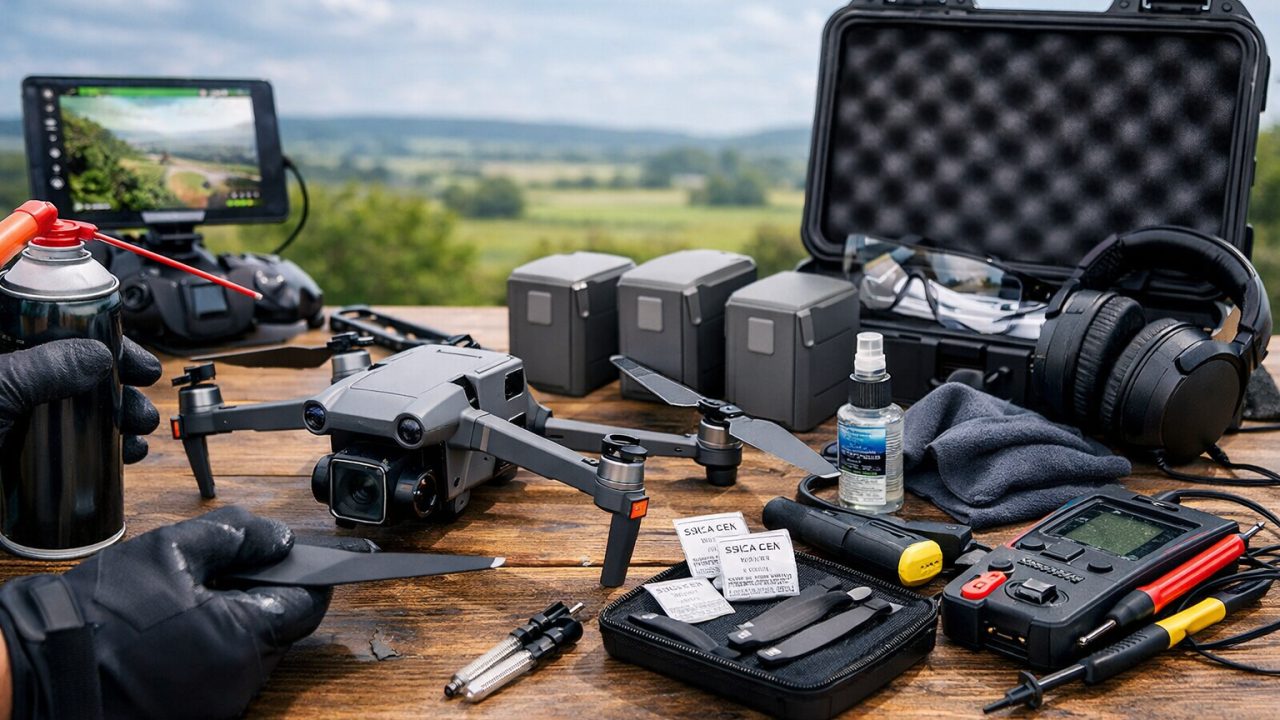
- Store drones with silica gel desiccant packs
- Replace or recharge desiccants regularly
- Fully dry aircraft before storage if exposed to moisture
Moisture damage is cumulative and often irreversible. Prevention is trivial. Repairs are not.
7. Keep It Clean – Dirt Accelerates Mechanical Failure
Dust, sand, and debris restrict airflow and infiltrate motors and joints.
After dusty or industrial operations:
- Blow out vents and motors with compressed air
- Wipe down the airframe with a microfiber cloth
- Inspect gimbal and sensor areas carefully
A clean drone runs cooler, vibrates less, and reveals early signs of wear during inspection. Cleaning is not cosmetic. It is preventative maintenance.
8. Propellers – Never Fly on “Slightly Damaged” Blades
Propellers are sacrificial components. Treat them as such.
Even small chips or cracks:
- Introduce vibration
- Stress motors and bearings
- Increase the risk of mid-air failure
Inspect props before every flight and replace immediately if damage is found. Always carry spares. Propellers are inexpensive. Crashes are not.
9. Firmware Updates – Stability Over Novelty
Firmware updates are important, but blind updating is risky.
Best practice:
- Read release notes before updating
- Delay non-critical updates for 1–2 weeks
- Monitor user feedback for issues
- Update only when necessary or when stability is confirmed
If your drone is performing reliably and the update does not address a specific issue you face, waiting is often the smarter choice.
10. Mindset – Longevity Starts With the Operator
The longest-lasting drones are owned by pilots who treat them as professional tools, not disposable gadgets.
That mindset drives:
- Better flight discipline
- Routine inspections
- Proactive maintenance
- Reduced risk-taking
Pilots who chase every new release often neglect the fundamentals. Those who master and maintain a single platform routinely get years more service from it. Longevity is behavioural before it is technical.
Final Thoughts
DJI drones are engineered to last, but only if operators meet them halfway.
Fly smoothly. Avoid unnecessary stress. Manage heat. Respect batteries. Store properly. Control moisture. Keep it clean. Replace wear items early. Update software intelligently. Operate with intent.
Apply these principles consistently and a five-to-seven-year service life is not optimistic. It is realistic.
At Coptrz, we specialise in professional drone maintenance, fleet support, and advanced operator training. If you want your DJI aircraft to remain reliable, compliant, and commercially viable for the long term, speak to our team.
Your drone is an asset. Treat it like one.
Download our FREE GVC Training Guide
Learn everything you need to know about becoming a drone pilot with our GVC training guide.
- Get a full course roadmap to understand every step of the journey
- Contains clear answers to all of the frequently asked questions
- Get a transparent and comprehensive breakdown of course costs

Related Posts

Pix4D v Drone Deploy v Agisoft: Comparing 3D mapping software for drones
Drones represent one of the great technological success stories of the 21st century so far, with unmanned aerial vehicles now used for a range of commercial applications, whether it’s parcel delivery or television filming. The rise in drone usage has led to the development of ever more sophisticated software, among which is 3D mapping software. What is 3D […]

NEWS FLASH: DJI Matrice 200 Series Firmware Update
DJI has announced there is a new firmware update (v01.01.0900) available for the M200 series. Here are some of the key updates announced: Added support for the DJI Zenmuse XT2 gimbal and camera (requires DJI Pilot App V0.6.0). Added payload SDK to support third-party payloads. Optimised the unlocking feature for Fly Safe. Optimised compass data […]

The Ultimate Drone Photography Package…
Coptrz is proud to announce, our latest collaboration with content creator Daniel Hughes. Our partnership with Daniel Hughes has been long-standing. Now we can finally reveal what we’ve been working on in partnership behind the scenes – the collaboration with our brand ambassador, Daniel, has resulted in the ultimate drone photography package which has been […]