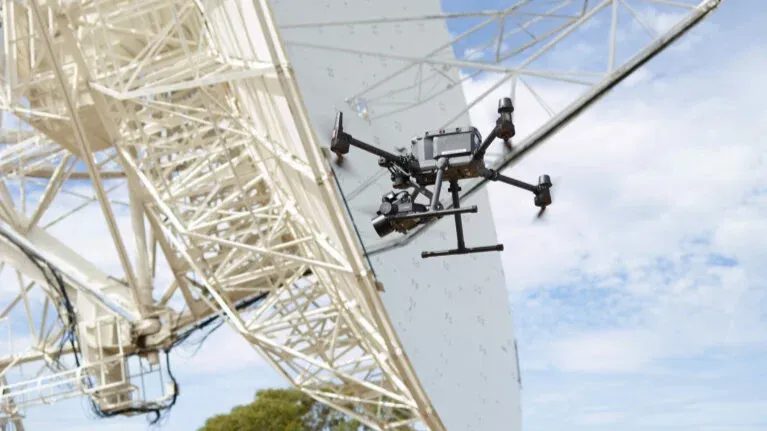
The University of Tasmania’s School of Natural Sciences set out to improve the precision of their 26-meter radio telescope at the Mount Pleasant Radio Telescope Observatory. This telescope plays a critical role in Positioning, Navigation, and Timing (PNT) research, capturing signals from distant galaxies to study Earth’s shape, rotation, plate tectonics, and timekeeping. These measurements underpin essential applications such as GPS, financial transactions, global communications, and navigation systems.
Overcoming Measurement Challenges with UAV Photogrammetry
To achieve the required accuracy, the research team needed to model and calibrate structural deformations in the telescope, which are influenced by factors like gravity. These subtle shifts can impact observational precision, making it crucial to quantify them with an accuracy better than 0.1 mm. Traditional ground-based surveying techniques proved insufficient, prompting the team to seek a more advanced solution.
Given the telescope’s large size and constantly shifting orientation, surveying its entire surface was challenging. Depending on its positioning, different gravitational deformations occurred, and some areas were inaccessible using traditional surveying methods. To tackle this, the University collaborated with UAV photogrammetry experts from Germany.
Ansgar Greiwe from Ruhr University Bochum of Applied Sciences emphasised that the most advanced drone-based imaging solution on the market was required for this project, Phase One’s P3 camera. With contributions from Michael Lösler and Cornelia Eschelbach of Frankfurt University of Applied Sciences, the team set out to analyze and assess the telescope’s structural deformations using cutting-edge aerial photogrammetry.
The Phase One P3: The Market’s Most Advanced Drone-Based Camera
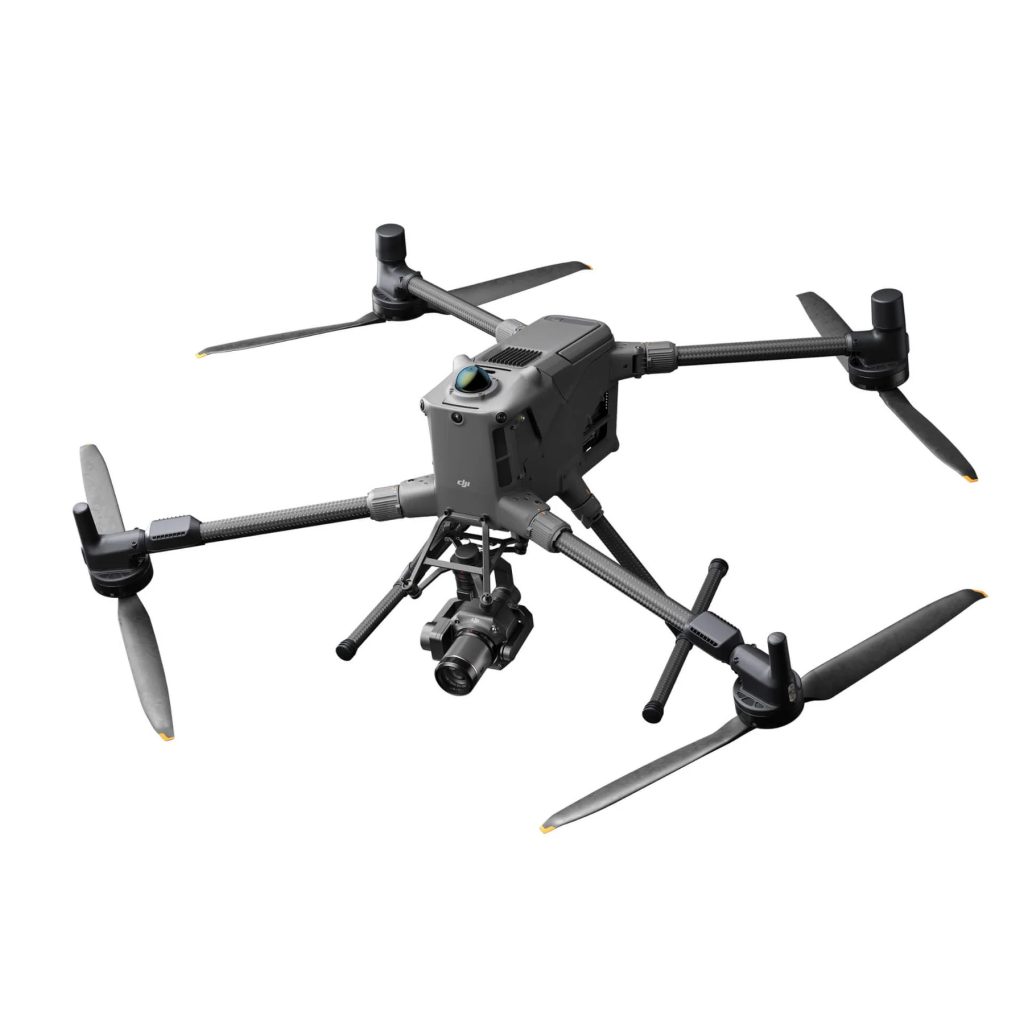
To carry out the survey, the team deployed the Phase One P3, the most advanced UAV-based photogrammetry camera available today, exclusively from Coptrz. Mounted on a DJI M350 drone, the P3 enabled the research team to achieve unprecedented measurement accuracy in the most challenging conditions.
The Phase One P3 is specifically designed for photogrammetry and mapping, offering an array of high-performance features:
- Ultra-High Image Quality: The P3 delivers outstanding resolution, dynamic range, and color accuracy, even in high-reflection environments like the telescope’s white dish.
- Superior Optics: With a medium-format sensor, the P3 provides sharper imagery and greater depth of field compared to standard drone cameras.
- Fixed Integration: Unlike cameras using gimbal stabilisers, the P3’s rigid mounting ensures pinpoint accuracy in photogrammetric surveys.
- No Image Distortion: Rigorous laboratory testing confirmed the P3’s images were distortion-free, even at the edges of each frame.
- Fast and Efficient Data Capture: With a rapid capture rate, the P3 reduces total survey time by up to 50% compared to cameras with smaller sensors.
- Seamless UAV Integration: The camera integrates directly with drone systems, allowing for real-time settings adjustments mid-flight.
Precision Surveying in Action
To ensure the highest level of accuracy, around 1,000 target points were placed across the telescope’s surface as reference markers. The team conducted over 200 flights, capturing more than 300 images per flight using different lens configurations. After testing an 80mm lens, which proved to have too narrow a field of view, they selected the 35mm lens for its ability to capture a broader section of the telescope while maintaining pinpoint precision.
The P3 camera’s performance exceeded expectations, producing flawless image quality, even when capturing shots directly toward the sun. Its high dynamic range and ability to capture crisp, high-resolution images in any lighting conditions were particularly beneficial when photographing the telescope’s highly reflective surface. Furthermore, the camera’s real-time parameter adjustment capability meant the team could adapt to changing light conditions mid-flight, maximising efficiency without the need to land the UAV.
Unparalleled Efficiency and Results
The efficiency of the Phase One P3 drastically reduced the time required for data collection, allowing the research team to complete the entire project within the limited window available for telescope access. Thanks to its large sensor and rapid capture rate, the P3 enabled the team to cut survey time in half, making large-scale structural analysis feasible where other methods would have fallen short.
By leveraging the advanced technology of the Phase One P3, available exclusively from Coptrz, this research project demonstrated how UAV photogrammetry is revolutionising precision measurement. The results of this survey not only refined the telescope’s calibration but also set a new benchmark for using drone-based imaging in high-accuracy scientific research.
For professionals requiring the highest level of aerial surveying precision, the Phase One P3 is the ultimate solution.
Get in touch with Coptrz today to learn how this industry-leading camera can transform your UAV surveying capabilities.
Download our FREE GVC Training Guide
Learn everything you need to know about becoming a drone pilot with our GVC training guide.
- Get a full course roadmap to understand every step of the journey
- Contains clear answers to all of the frequently asked questions
- Get a transparent and comprehensive breakdown of course costs

Related Posts
An In-Depth Look at the Mavic 2 Enterprise
When the original Mavic drone was launched back in 2016, it was marketed as a high-end consumer drone. But the platform’s ease of use, extensive payload options and affordability meant it found popularity in a number of industries including construction, surveying and search and rescue. So when DJI launched the updated Mavic 2 Zoom and […]
COPTRZ DRONE-FLX Leasing Solution Now Available
COPTRZ has today announced the release of DRONE-FLX, an industry-first leasing solution that provides a cost-effective way for businesses and public bodies to enjoy the benefits of the latest drone technology. With costs spread over a three-year period, the latest drone hardware can be bundled with training and software to enable an effective drone strategy […]
Top Drones for Police in 2024
In recent years, the integration of drones in the police force has significantly transformed policing strategies, not just within the United Kingdom, but globally. The use of drones in policing offers a unique blend of efficiency, safety, and versatility, making them indispensable tools in a vast amount of policing tasks. From aerial surveillance and crime […]