When flying your drone, you are the sole person responsible for ensuring that it’s flown in a safe manner. This does not just include the safety of the drone itself, but also considering the safety of yourself, other people in the area and the environment too. Whether you are flying for surveys, filming or just for pleasure, there are many factors you must consider before getting down to flying.
Safety should be considered as a necessity when flying your drone. Safety starts with planning, and thorough planning must be undertaken to reduce the risk of accidents happening. If something does go wrong, the damages incurred might be more than just a damaged drone. Business reputation, time and resources can all be common consequences, along with the risk of costly repayments if a property or an individual is hit.
As such, COPTRZ has put together a short guide on how to maintain a safe environment while flying your drone, to help minimise the risk of accidents.

1. Undertake an initial site safety assessment
The area in which you are flying your drone needs to be considered before the flight, especially if flying indoors, or in an area with low hanging trees or rocks. Along with the flight space, a thorough investigation of the takeoff and landing areas should be undertaken. Plans must be adapted to any external intrusions, and all loose debris should be cleared away.
Standard flight distances should be maintained throughout the flight. The Civil Aviation Authority (CAA) recommend that the drones should always be at least 30m away from crowds at take off and landing, and at least 50m away from people when in flight.
A site safety assessment also means checking the environment too. Wind speeds must be considered, to ensure that you can control the drone. The direction of the wind must be known to ensure you can adjust your flight patterns and power accordingly. Finally, while it may sound obvious, you cannot confirm a safe environment by checking the weather forecast. Even if the weather looks okay at the present time doesn’t mean it won’t suddenly become windy and rainy, both of which will make flying your drone unsafe.
2. Check the condition of your equipment
The drone itself must always be visually inspected before and after every flight to check for damage. Even the slightest problem can have significant consequences while the drone is in flight, so never fly if the machine does not appear 100% airworthy. In addition, all drones and controllers should be fully charged. If working from internal integrated battery systems, or new batteries should be inserted if your drone or controllers use these.
Having a drone fall out of the sky due to a lack of power is extremely easy to avoid. It can be disastrous if it happens, often destroying the drone beyond repair. It can also impact the environment negatively, and running the risk of damaging people and property.

3. Ready a safety kit
Safety kits are absolutely essential to help protect you and the general public around you when flying. This should include a fully stocked first aid kit, and you should have the knowledge of basic first aid, along with how to use all of the first aid materials present in the kit.
Fire extinguishers are also a must. Even though it is extremely unlikely your drone will catch fire, all risks must be acknowledged and prepared for. Depending upon the area you are working the drone, a helmet and safety goggles may also be necessary.
The COPTRZ Drone Pilot Safety Kit has been specifically designed to include all of the items you need to ensure that you are operating safely during every drone flight. In the safety kit, you’ll find an anemometer, fire extinguisher, hard hat, hi-viz vest, safety goggles, first aid kit, collapsible safety cones and heavy duty holdall.
4. Obtain a ‘Permission for Commercial Operations’ (PfCO)
In order to operate a drone commercially in any part of UK airspace, the operator must legally get a PfCO from the CAA. Before August 2016, this was known as a ‘Permission for Aerial Work (PfAW). To get a PfCO you must prove to the CAA that you can operate a drone safely. You must demonstrate theoretical competence and standard operation procedures. This is due to the high frequency of use of the UK’s airspace. Also, an improperly handled drone can cause damages and injuries to property and person.
To get a PfCO, a pilot has to undertake a recognised CAA training course. Not only will this give you the legal permission to commercially operate a drone in UK airspace, it will also help improve your flying skills and overall drone safety.

At COPTRZ, we pride ourselves on being commercial drone experts. As well as selling a wide range of drones, accessories, software and equipment, we also provide comprehensive training, including courses that have been approved by the CAA. For more information about our products and services, contact one of our friendly drone experts at https://coptrz.com/contact-us/.
Read more of our articles:
- The critical factors to consider in a drone pre-flight checklist
- Fixed Wing vs Multirotor drones for surveying
- 5 tips for adding value to your drone service
- LiDAR sensors for drone: top 5 options
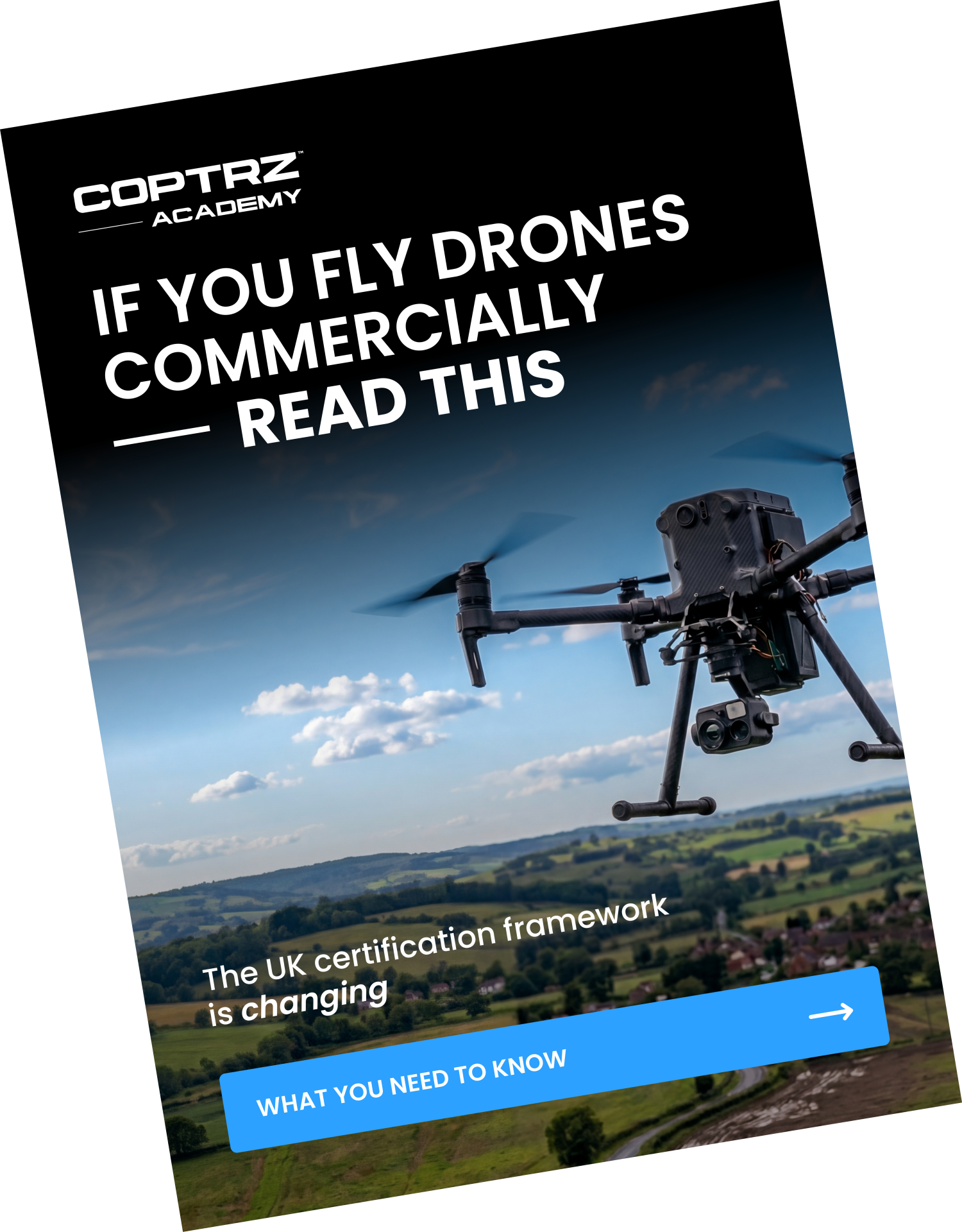
Download Our FREE RPC-L1 Guide
Understand everything you need to know about moving towards commercial drone operations with our RPC-L1 guide.
- Understand what RPC-L1 is and who it is for
- Learn how the CAA transition impacts operators and training routes
- Get a clear breakdown of requirements, costs and next steps
Related Posts

Drone Detection Systems Protecting Prisons
In today’s modern world, we now have technology to do almost everything for us: cars can be driven without drivers, smartphones can turn on appliances from outside the house, and we can instantly communicate with people on the other side of the world. In addition to all of these things, there is another area of […]

The Role of Drones in Education: Enhancing Surveying, Construction, and Beyond
Drones, or Unmanned Aerial Vehicles (UAVs), have revolutionised various industries, including education. In the UK, institutions are increasingly integrating drones into their curriculum, particularly in surveying, construction, and other technical fields. Their ability to provide real-time data, improve safety, and enhance learning experiences makes them invaluable tools for students and professionals alike. Drones in Surveying […]

New Drone Laws 2019, Part 2
In a previous article, we covered the basics in terms of what actual changes are being made to the rules and regulations for drone use in the UK. However, there’s a lot more in the government’s recently released response to the ongoing consultation period as it continues to shape and evolve the law in collaboration […]